Dr. Joe & Alice Rinard Orchid Greenhouse Website
Project Overview
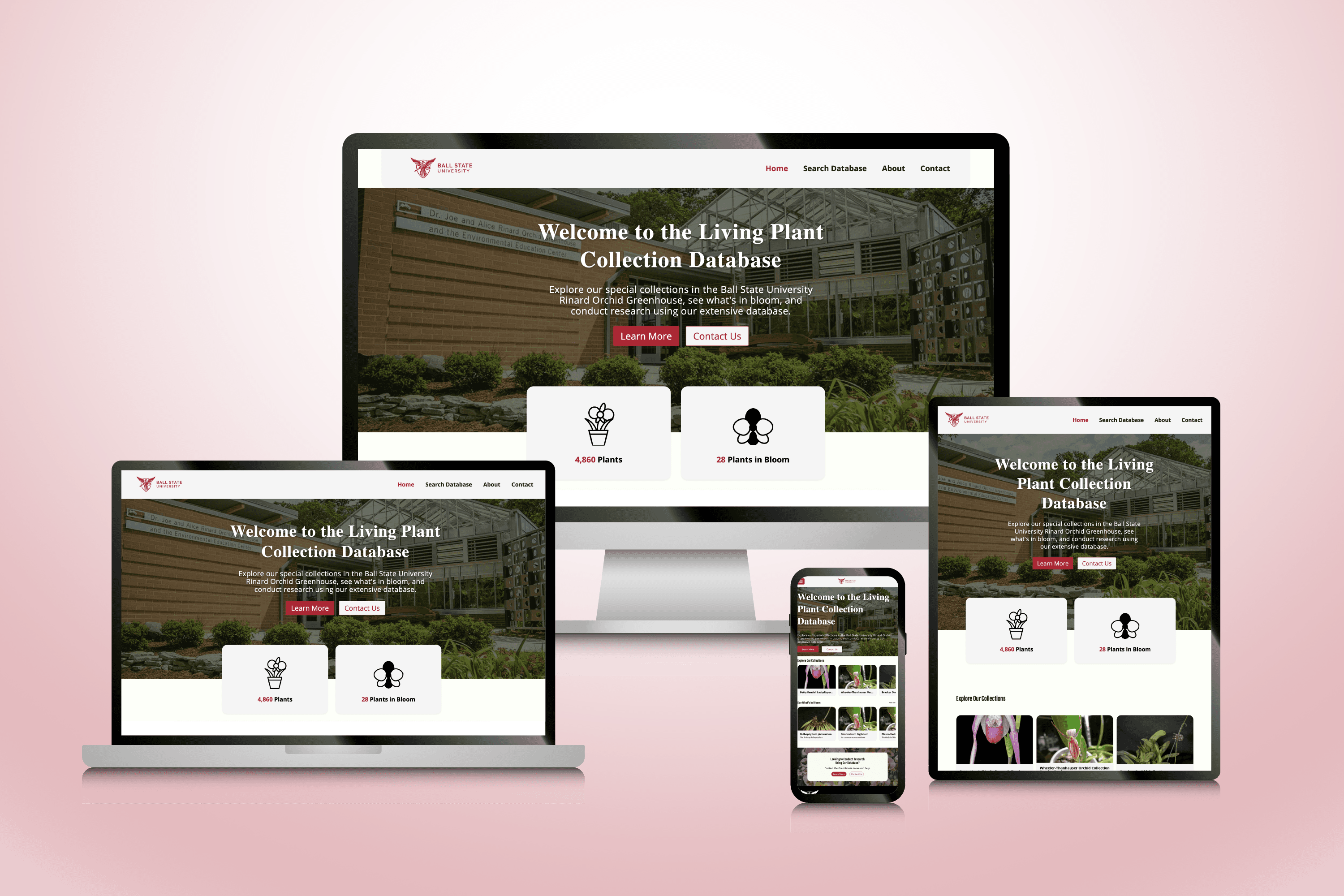
The Orchids website is a searchable digital database for Ball State University’s orchid collection — one of the largest collegiate orchid greenhouses in the U.S. The platform was designed to support researchers, students, and visitors by making thousands of structured plant records accessible, navigable, and actionable. Our challenge was to transform complex botanical taxonomy and seasonal bloom data into an intuitive experience that supports both scientific research and casual exploration.
Our goal was to design a scalable digital platform that:
Centralizes 4,000+ orchid records
Supports variable taxonomy structures
Serves both researchers and public visitors
Allows non-technical staff to update content easily
Automatically syncs backend updates to the public website
This project required designing not just an interface — but a system that bridges research workflows and visitor experience.
Role
UX / Web Designer
Client
Ball State University
Scope
Wireframes
Interface design
Site build
Search and filtering tools
THE PROBLEM
The greenhouse maintained extensive orchid data, but there was no streamlined digital interface that allowed users to:
Efficiently search by genus, species, or partial names
Filter by characteristics
Understand bloom timing at a glance
Plan visits based on seasonal availability
The existing information was technically rich but experientially fragmented.
We needed to design a system that could:
Scale with structured botanical data
Support both expert and novice users
Bridge digital research with real-world visitation
CHALLENGES
Scale & Variability
4,000+ orchids in the database
Each entry includes multiple data fields
Taxonomy varies significantly:
Some plants have a single species name
Others may have 10–15 associated hybrid or classification names
We had to design UI patterns flexible enough to accommodate inconsistent data structures without overwhelming the user.
Replacing Manual Workflows
The greenhouse previously relied on paper records and spreadsheets.
This created friction:
Routine checks were tedious
Data wasn’t centralized
Public visitors had no easy way to access plant information
The client needed:
A backend system simple enough for non-technical staff
A front-end experience accessible to the public
Automatic syncing between the two
This meant UX wasn’t just about the end user — it was also about the content managers.
CMS & Technical Constraints
We were limited in our website builder and CMS selection.
Every design decision had to answer:
Can the client realistically maintain this?
Can developers structure this within CMS limitations?
Will this scale as thousands of additional records are entered?
90% of the orchid data is still being entered — meaning the system had to be designed for long-term growth from the start.
DISCOVER
The primary challenge was to make a large dataset of orchid information accessible and meaningful to different kinds of users — including biology students, greenhouse volunteers, hobbyists, and general visitors.
None of our team had prior plant expertise.
We met weekly with the client to:
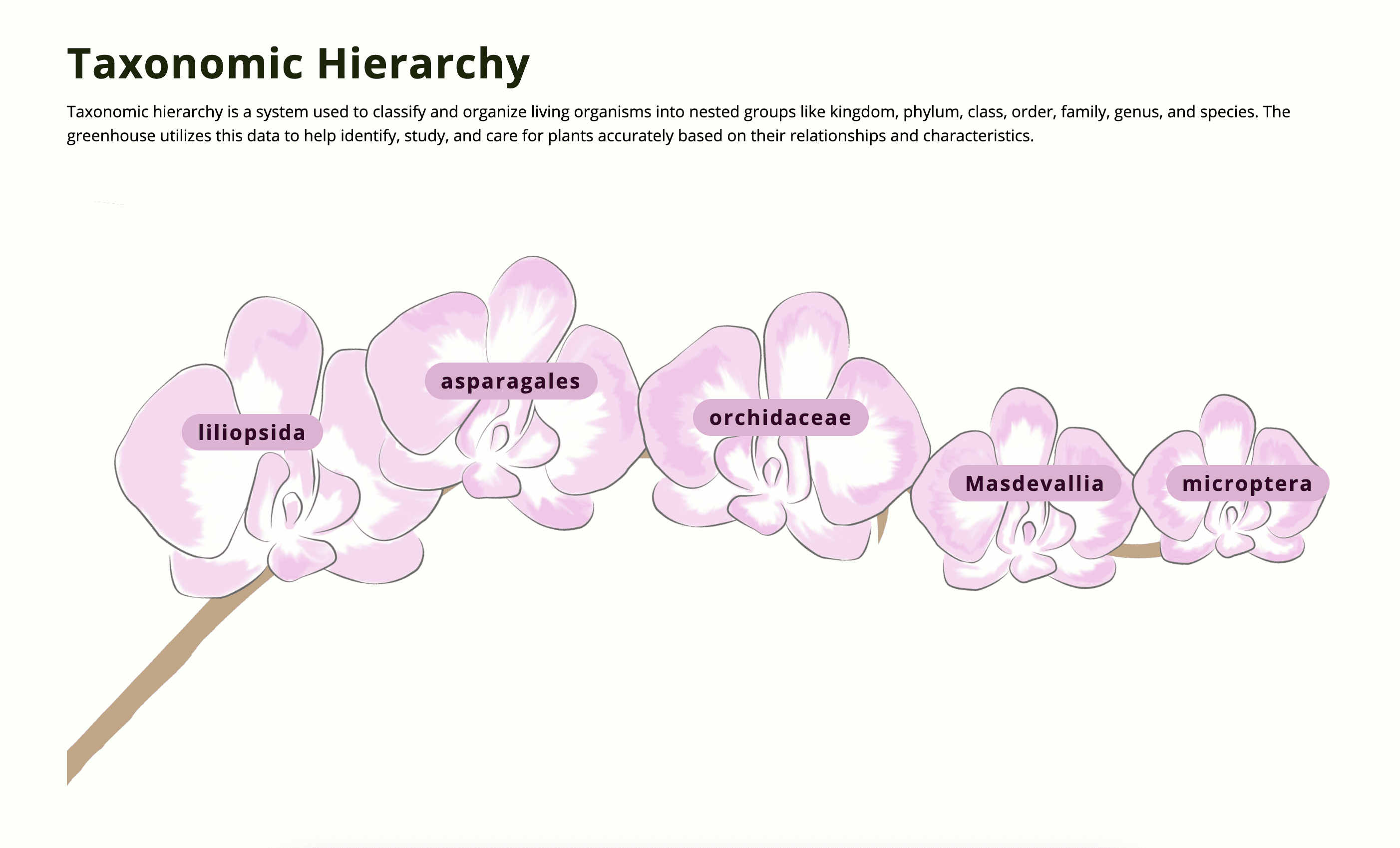
Understand orchid taxonomy
Learn how bloom cycles are recorded
Clarify how routine checks are documented
Identify which data fields were essential
This immersion phase was critical. Without it, we would have risked oversimplifying scientific classification structures.
We also mapped how different users approach the database:
Researchers searching by precise genus/species
Visitors browsing visually
Guests planning seasonal visits
This helped us prioritize search, filtering, and seasonal visibility.
Keyfindings
Orchid collections like the Rinard Orchid Greenhouse hold thousands of species and hybrids, and users often seek specific scientific or common names.
Existing orchid databases often feel overwhelming without clear filters or intuitive search.
DEFINE
From research and early discussions we defined core problems:
Users struggled to efficiently search and find orchid species across large datasets.
There was no unified, user-friendly interface to present both scientific data and visual elements in one place.
The information architecture needed to be both intuitive and scalable as more orchids are documented.
Problem Statement
How might we design an interactive, accessible platform that help users discover orchids from the collection by name, attributes, and visual traits?
Functional Requirements
A responsive search tool with typeahead suggestions
Category filters (genus, species, bloom characteristics)
Accessible species detail pages
Clean visual hierarchy optimized for both mobile and desktop
DEVELOP
Structural Approaches
A simplified homepage with prominent search input
Progressive filters for narrowing results
Card layouts for results showing key info at a glance
Species detail pages with images, descriptions, and taxonomy
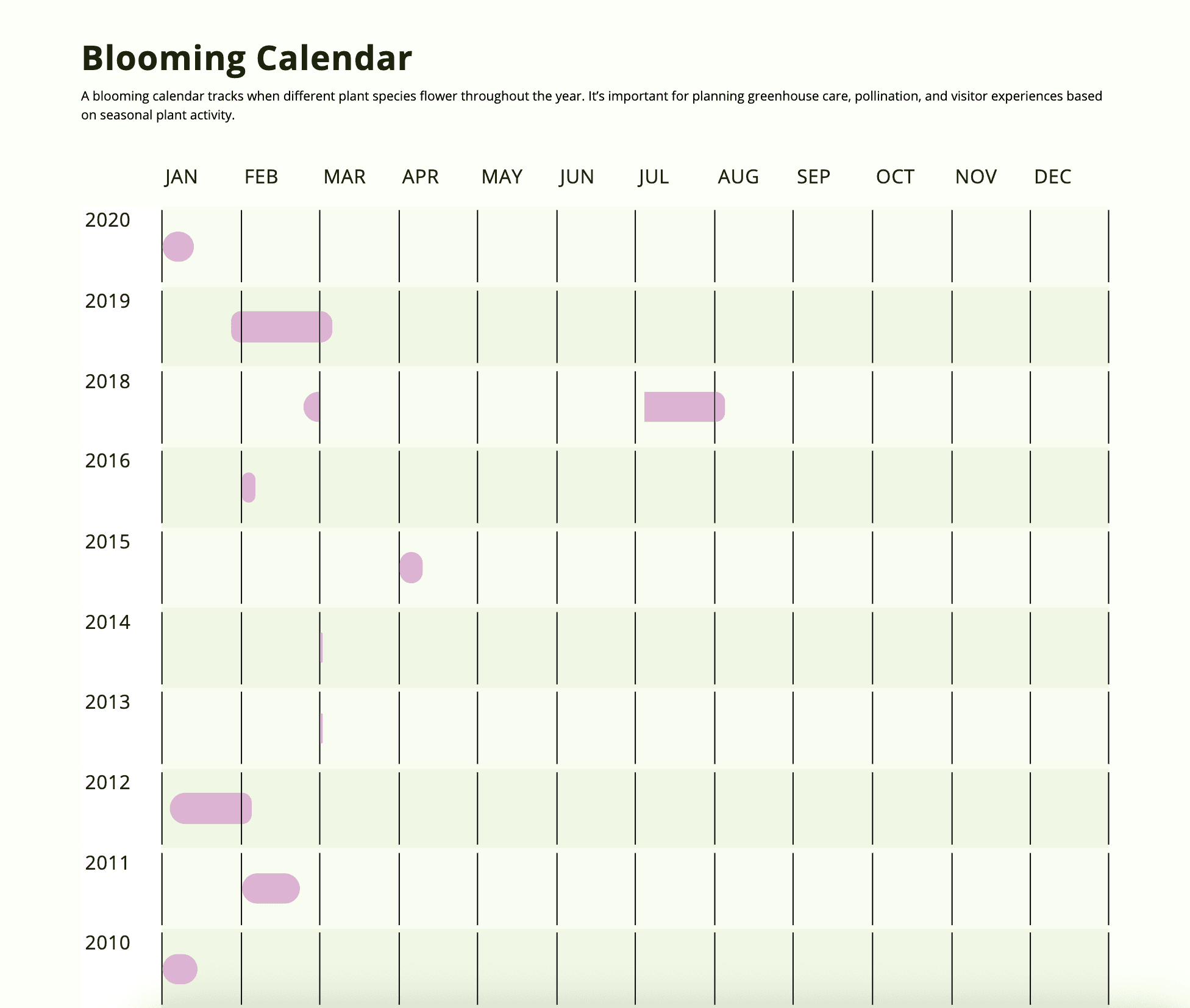
During the ideation phase, we recognized that many users weren’t just researching orchids — they were planning visits to the greenhouse. While species data was helpful, users also needed to know when orchids would actually be in bloom.
This insight led us to introduce a Bloom Chart feature.
Instead of requiring users to click into individual species pages to check bloom times, we designed a visual bloom calendar that:
Displays peak bloom months at a glance
Allows users to scan seasonally
Helps visitors plan greenhouse trips around specific orchids
Supports both casual visitors and academic users
The bloom chart shifted the site from being purely informational to becoming actionable.
Numerous Iterations
Search UI
Filter systems
Card vs list formats for results
Iterations
Adjusted colors and patterns based on visibility in real-world lighting and quick decision readability on menus.
Simplified certain mural elements that visually conflicted with regulatory truck signage requirements.
FINAL DESIGN
Dr. Joe & Alice Rinard Orchid Greenhouse Website (still being updated with content and information)
WHATS NEXT
Future roadmap items include:
QR code integration so visitors can scan physical plant cards and instantly access species pages
Expanded filter functionality as database grows
Increased dataset completion
The QR integration will further bridge physical and digital experiences — something the current system is structurally prepared to support.
CONCLUSION
Impact
Although specific metrics (sales, engagement data) were not directly collected, the project achieved clear design goals:
The database supports both scientific research and general exploration of orchid species.
Users can efficiently find specific orchids by attributes, improving learning outcomes.
The project demonstrates how thoughtful UX design can make complex biological data approachable and engaging.
Learnings
This project was a milestone in my transition toward data-driven UX and web design because it demanded that I think about how people interact with large, structured information — not just how things look.
One of the most valuable lessons came from designing the search and discovery experience. It’s easy to assume users know what they’re looking for, but many times they begin with only partial names in mind. Crafting a system that supports both precise scientific naming and looser exploration taught me the importance of flexible search paradigms — from typeahead suggestions to progressive filters.
Working closely with structured data taught me how crucial information architecture is when designing tools that scale. I learned to break down complex taxonomy into digestible UI patterns so users aren’t overwhelmed but still have access to depth.
This project also reinforced a core UX principle: design is not something you put on at the end , it’s woven into how users understand and navigate content. By aligning research insights with interface decisions, we created a tool that feels intuitive even though it holds thousands of data points.
Growth
Visual search enhancements
Interactive species maps to show origins or greenhouse locations
User accounts for botanists to contribute notes or observations
Overall, this project didn’t just improve my technical skills — it changed how I approach design for complex content experiences.